

Archaeologists from the University of Leicester Archaeological Services (ULAS) have uncovered remarkable evidence of 2,000 years of human activity beneath Leicester’s market place — including a Roman infant burial and the remains of a long-lost civic landmark.
The discoveries were made during excavations alongside redevelopment works for the city’s new market square, which began in July.
So far, the ULAS team has revealed a rich sequence of archaeological remains, spanning from Roman times to the medieval and early modern periods.
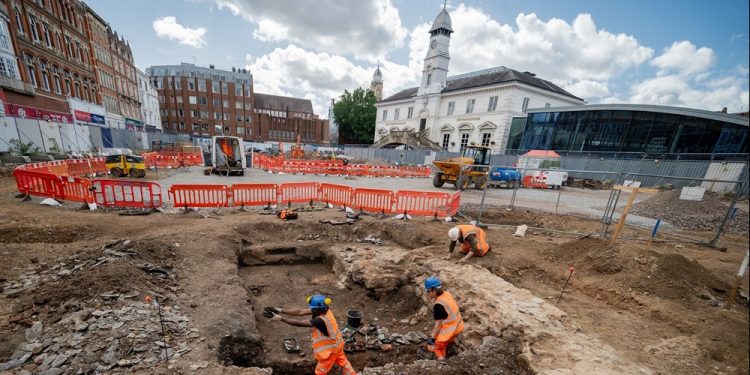
Picture credit: Speller Metcalfe
One of the most poignant finds is the grave of a Roman infant, buried beneath the floor of a timber building almost 1,800 years ago. Nearby, the team also uncovered rare Roman pottery kilns, offering fresh insights into everyday life and industry in Roman Leicester.
From the medieval period, excavations revealed early market surfaces, a stone-lined well, and the remains of a dungeon described in the 16th century as “a most vile prison.” This dungeon is believed to be part of the Gainsborough Chamber, a prominent civic building recorded as early as 1533.
The Gainsborough Chamber served as a venue for mayoral business, feasts, and judicial proceedings until its demolition around 1748. Its recently uncovered thick stone walls underline its architectural and civic importance.
Dr Gavin Speed, who is leading the dig for ULAS, said: “Leicester is one of the most archaeologically explored cities in the UK, but this part of the market had remained largely untouched until now.
“We expected to find Roman remains, but the quality and preservation have exceeded expectations — including the discovery of two Roman buildings and the deeply moving burial of an infant beneath one of them.”
The later Roman building, constructed in stone over the earlier timber structure, yielded tesserae (used in mosaics), pottery, coins, and jewellery — helping piece together daily life in Roman Leicester.
Above the Roman layers, thick soils dating to the little-understood Anglo-Saxon era were found, which may shed light on post-Roman settlement in the city.
Just below the modern surface, archaeologists identified the earliest medieval market layers — a series of compacted pebbles, silts, and resurfacing layers that span 800 years of market activity. Post-holes preserved from medieval stalls were also found, offering rare physical evidence of the market’s layout through the centuries.
City Mayor Peter Soulsby said: “Before the market is paved for the future, it’s vital we explore and understand its past.
“The work of ULAS is revealing how this site has been in continuous use for millennia — with traces of Roman, medieval, and Victorian Leicester all buried beneath our feet.”
ULAS will continue to work alongside contractors Speller Metcalfe to document and preserve as much as possible. The city council hopes to display some of the most significant finds for the public to enjoy.