

A man from Leicestershire has been banned from keeping animals for a decade after a severely emaciated horse was found in his care—so thin that an inspector could feel the bones of its windpipe through its neck.
The horse, a 25-year-old named William, was later euthanized due to his condition.
Luke Pepper, 26, received a 10-year ban on keeping animals. He was also handed a 10-week prison sentence, suspended for 12 months, and must complete 15 Rehabilitation Activity Requirement (RAR) days. Additionally, he was ordered to pay £750 in costs and a £154 victim surcharge.
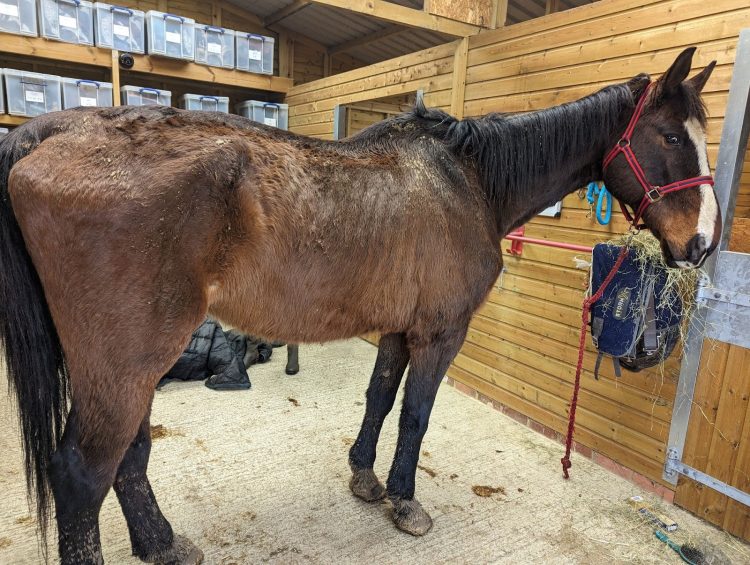
Picture credit: RSPCA
The incident occurred in March of last year, when the RSPCA, accompanied by police, an independent vet, and a World Horse Welfare officer, visited a farm in Northamptonshire.
RSPCA Inspector Susan Haywood, who attended the scene, described William—who stood 17 hands high—as wearing a torn lightweight rug. When the rug was removed, his deteriorated condition was immediately apparent. His ribs, hips, and spine were all clearly visible, and he had no muscle mass. Shockingly, when she ran her hand down his neck, she could feel the bones of his trachea—something she said she had never encountered before.
William had no access to grazing, and the hay provided was stale, trampled, and contaminated with faeces. The area he was kept in was also hazardous, containing broken glass, tools, and machinery that could have caused him harm.
With a body condition score of just 0.5 out of 5, William was classified as emaciated—a serious welfare concern. He was seized by police and taken to a boarding facility for further veterinary assessment.
A vet’s report stated: “In my professional opinion, William has suffered severely for an extended period of time. This level of emaciation, absent any major disease, explains his exhaustion, poor demeanour, and depression. His nutritional needs were not being met.”
Inspector Haywood added: “William was in an emaciated condition, with virtually no body fat, and his behaviour was subdued.”
Despite receiving care for a year under the RSPCA, William continued to suffer due to chronic conditions including arthritis and lameness. It was eventually determined that euthanasia was the kindest option.
In mitigation, the court heard that Pepper had experienced personal difficulties and was still a young man, but accepted responsibility for his actions.